Better Together: How West Coast Artists Are Turning Cross-Genre Collabs Into a Movement
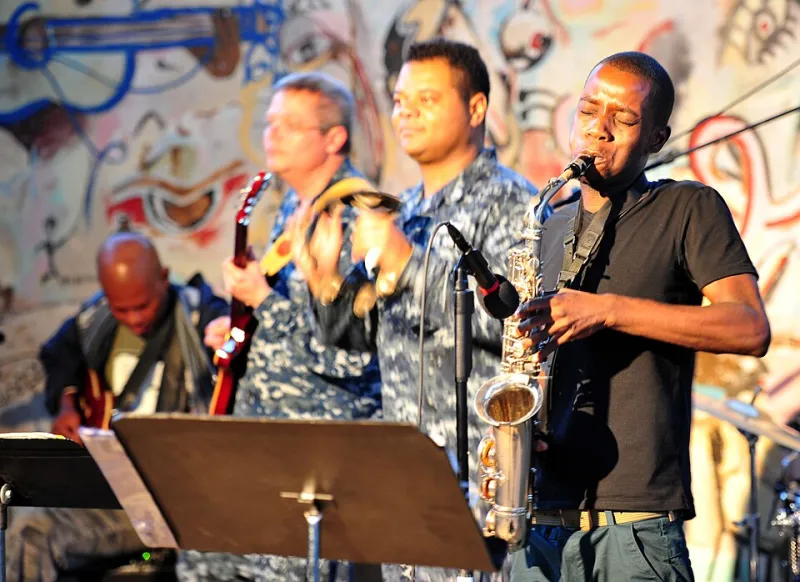
Photo: Petty Officer 1st Class Martin Wright, Public domain, via Wikimedia Commons
Let's be honest: the music industry has always loved a rivalry. East Coast versus West Coast. Hip-hop versus rock. Underground versus mainstream. The narrative of competition sells, and for a long time, it shaped how artists positioned themselves and how fans chose sides.
But spend any real time paying attention to what's coming out of California, Oregon, and Washington right now, and you'll notice something that cuts against all of that. The most exciting music on the West Coast in 2024 isn't being made in isolation — it's being made in rooms full of artists from completely different worlds who decided that working together was more interesting than working alone.
This isn't a trend. It's a ethos. And it's starting to feel like the defining characteristic of the West Coast sound right now.
Genre Is a Starting Point, Not a Fence
Here's the thing about labels like "hip-hop" or "indie rock" or "R&B" — they're useful shorthand, but they've never told the whole story of how music actually gets made. West Coast artists have long understood this intuitively. From the jazz-inflected production of '90s LA hip-hop to the psych-rock undertones of Bay Area indie acts, the lines here have always been more porous than the genre bins at your local record store would suggest.
What's different in 2024 is the intentionality. Artists aren't just borrowing from each other's sonic vocabulary — they're actively building creative partnerships that treat genre as a starting point rather than a destination. You've got bedroom electronic producers linking up with live jazz musicians from Leimert Park. Singer-songwriters from Portland's folk scene co-writing with R&B vocalists from Inglewood. Seattle-based experimental acts sharing studio time and mixing credits with hip-hop producers from Tacoma.
The results are genuinely hard to categorize, which is exactly the point.
Why the West Coast Does This Better
Opinion incoming: no other region in the US does this as naturally or as well as the West Coast, and there are real structural reasons for that.
Geographically, cities like LA, the Bay Area, Portland, and Seattle each have their own distinct musical identities — but they're connected enough through touring circuits, social networks, and shared cultural references that cross-pollination happens organically. An artist from Oakland can play a show in Portland, crash with a local musician, and walk away with a half-finished collaboration that neither of them could have made at home.
Culturally, the West Coast has always been a place where people come to reinvent themselves. The immigrant communities, the LGBTQ+ scenes, the tech-adjacent creative classes — they've all contributed to a cultural environment that values innovation over tradition and connection over hierarchy. That shows up in the music.
And practically? The cost of recording technology has dropped dramatically, which means more artists are making records in home studios where the guest list is just whoever's around and willing to try something. That informal energy breeds experimentation in a way that a formal studio session with a producer and an A&R rep in the room never quite does.
The Projects That Prove the Point
You don't have to look hard for evidence that this collaborative spirit is producing real results. Across the West Coast, joint projects and surprise features are generating some of the most talked-about releases of the year.
In LA, the intersection of the Afrobeats scene with the city's homegrown hip-hop community has produced a wave of tracks that feel genuinely global while still carrying that unmistakably SoCal energy. Up in the Bay, the ongoing dialogue between electronic producers and live instrumentalists is pushing both communities into territory they wouldn't have explored on their own.
Portland's indie scene — which has always had a slight inferiority complex relative to the bigger coastal cities — is quietly putting out some of the most sonically adventurous music in the country, largely because artists there have fewer industry gatekeepers to answer to and more freedom to collaborate across scenes without anyone questioning whether it's "on brand."
Seattle, meanwhile, is in the middle of a genuine creative renaissance driven in large part by a new generation of artists who grew up with access to global sounds via streaming and social media, and who feel zero obligation to stay in their lane.
Competition Isn't the Vibe
There's a generational shift happening here too, and it's worth naming. Younger West Coast artists — the ones in their early-to-mid-20s who are just now finding their footing — seem genuinely less interested in the zero-sum competition mindset that defined earlier eras of the music industry. They grew up watching their favorite artists collaborate across genres on streaming platforms, they built their early audiences on TikTok where the algorithm rewards novelty over genre loyalty, and they're more likely to see another artist as a potential creative partner than a rival.
"I don't really think about who I'm competing with," one LA-based R&B artist said recently in an interview. "I think about who I want to make something with. That's a more interesting question."
That mindset has real commercial implications too. Cross-genre collaborations reach multiple fanbases simultaneously, creating organic discovery moments that no marketing campaign can manufacture. When a hip-hop artist features an indie vocalist, both artists get introduced to an entirely new audience — and if the music is good, those audiences tend to stick around.
The Scene Is the Product
Ultimately, what's most exciting about the West Coast collaborative moment isn't any single project or pairing — it's the scene itself. The network of relationships, the shared creative spaces, the culture of showing up for each other's gigs and sessions and release parties. That's the infrastructure that makes the music possible, and it's what makes the West Coast feel genuinely different from other regional scenes right now.
The rivalry narrative is dead. Collaboration is the new competition. And honestly? The music has never sounded better.
Stay locked in to West Coast Poppin' for the latest on artists, releases, and the collaborations reshaping the sound of the scene.