Gold in the Gutter: West Coast DJs Are Finding Their Biggest Hits in Dusty Bins and Estate Sales
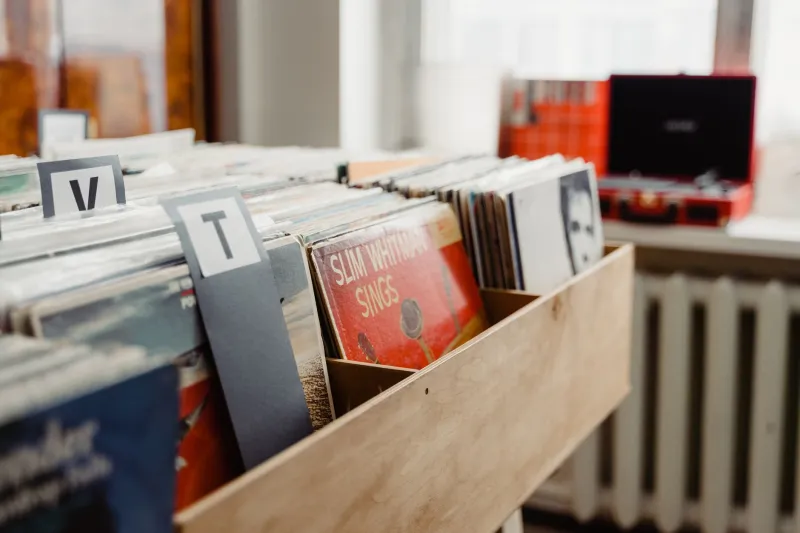
There's a particular kind of silence that falls over a DJ when they flip a record they've never seen before, drop the needle, and hear something that makes their whole body stop. No algorithm suggested it. No playlist curator flagged it. It was just sitting there in a milk crate at a Pasadena estate sale, sandwiched between a Herb Alpert record and a warped copy of something nobody wants. And it's perfect.
This is the world West Coast crate diggers are living in right now — and it's louder than ever.
While the music industry keeps doubling down on data-driven discovery and AI-assisted A&R, a growing crew of DJs from LA to Oakland to Seattle are doing something almost radical by comparison: they're going analog, going physical, and going deep into the forgotten corners of recorded music history to find the sounds that streaming never surfaced.
The Hunt Is Half the Thrill
Ask any serious digger and they'll tell you the same thing — the search is its own reward. DJ Mira Solano, a Los Angeles-based selector who splits her time between underground club nights in Silver Lake and a weekend residency in Long Beach, estimates she hits at least three thrift stores and one estate sale every week. Her record collection has outgrown two apartments.
"People think I'm out here looking for famous stuff," she says, flipping through a stack of 45s on her kitchen table. "I'm not. Famous stuff is already found. I want the regional pressings, the private labels, the church choir records, the local funk bands that only pressed five hundred copies. That's where the fire is."
Solano went viral last year after a short clip of her mixing a 1974 soul record she'd found at a Salvation Army in Inglewood circulated on TikTok. The original artist — a session musician who'd released the record under a pseudonym — reached out within 48 hours. The moment racked up over two million views. The record itself sold for several hundred dollars on Discogs the following week.
"That's the thing nobody talks about," she says. "When you surface something real, people feel it. They don't know why, but they feel it."
Analog Discovery in a Digital World
It might seem counterintuitive that vinyl hunting is having a moment precisely when music has never been more accessible. But that accessibility is exactly the problem — or at least, that's how the diggers see it.
When every song ever recorded is theoretically a tap away, nothing feels rare. Nothing feels like a secret. The intimacy of discovery, the sense that you've found something nobody else has, gets flattened into an infinite scroll. Crate digging is the antidote to that. It reintroduces friction, and friction creates meaning.
Oakland-based DJ and producer Terrence "Tek" Holloway has been digging since he was a teenager tagging along to flea markets with his uncle. These days, he's known for flipping obscure West Coast jazz and soul samples into beats that blur the line between club music and something you'd hear in a museum installation. His process is methodical — almost obsessive.
"I keep a notebook," he explains. "Every record I find that has potential, I log it. The label, the catalog number, the condition, what I hear in it. Sometimes I sit on a record for two years before I figure out what to do with it. And then one day it just clicks."
One of those clicks came when Holloway discovered a private-press Latin soul record at a swap meet in Fresno. He'd paid three dollars for it. The bassline he lifted from the B-side became the foundation of a track that landed on a major label compilation and got licensed for a national TV spot. He still has the original record framed above his studio desk.
TikTok Meets the Turntable
What's changed in the last few years is how quickly a vinyl find can travel. The pipeline from dusty bin to viral moment has compressed dramatically, and West Coast DJs are leaning into it.
Short-form video has become an unexpected showcase for crate culture. Clips of DJs reacting to needle drops — that electric moment when an unknown record reveals itself — perform remarkably well online. There's something universally compelling about witnessing genuine surprise, about watching someone discover something in real time.
DJ Camille Okafor, who runs a popular TikTok account alongside her DJ work in San Diego, has built a following of nearly 400,000 people almost entirely on the back of crate-digging content. Her format is simple: she films herself at thrift stores, narrates her thought process as she flips through records, and then shares the needle drop reaction at home.
"People are hungry for real moments," she says. "Everything online feels so produced and packaged. When I'm genuinely losing my mind over a find, that energy is contagious. I've had people message me saying they started digging because of my videos. That's wild to me."
Okafor is also intentional about crediting the original artists whenever she can identify them — a practice she says matters both ethically and culturally. "A lot of these records were made by Black artists, Latino artists, people who never got paid what they deserved the first time around. If I'm going to celebrate what they made, I want their names attached to it."
The Community Behind the Crates
Crate digging has always had a community dimension, but that community is expanding and evolving. In Los Angeles, informal digger meetups have started popping up in record shops and community spaces, where DJs trade tips on upcoming estate sales, debate the merits of certain pressing plants, and share finds over cheap beer and good music.
These gatherings are notably diverse — in age, background, and genre allegiance. You'll find a 60-year-old who was pressing records in the '70s standing next to a 22-year-old who got into vinyl because of a YouTube rabbit hole. The common language is curiosity.
"There's no gatekeeping here, at least not in the circles I run in," says Solano. "If you're genuinely passionate about the music, you're welcome. The records don't care who finds them."
For Holloway, the community aspect is inseparable from the creative one. "Digging alone is cool, but digging with people who know things you don't know — that's an education. I've learned more about music history in record stores than I ever did anywhere else."
Why It Matters Now
In a landscape where music production has become increasingly democratized and homogenized — where the same sample packs and plugin presets are available to millions of producers simultaneously — the diggers are doing something quietly subversive. They're finding sounds that aren't in any library, that can't be licensed from a stock music site, that exist only because someone pressed them onto vinyl decades ago and they somehow survived.
That specificity is a form of power. And on the West Coast, where music culture has always had one foot in the underground and one eye on what's next, the diggers are writing the next chapter from the bottom of a cardboard box.
The algorithm will catch up eventually. It always does. But by then, the real ones will already be at the next sale, flipping through another stack, chasing that silence before the needle drops.